Showing posts with label Cities. Show all posts

Immersive Cities

Githyanki Diaspora had a post titled "Reddit GM Advice: Established Settings, Immersive Cities, and Clues in Investigation Games"

The part that interested me was the Immersive Cities. The basic question is

How do I make a large city experience immersive? What things should I keep in mind given they will only be in this city (initially) for two or three sessions. Should I instead lengthen their stay and make an adventure out of it?

I want to make sure this doesn’t feel like “just another city” for them.

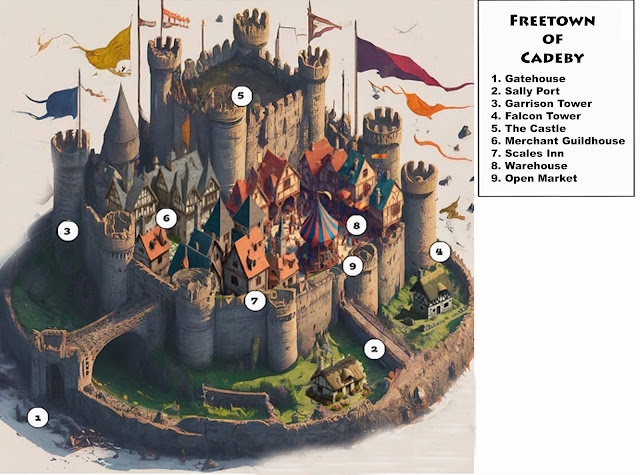
The answers are not bad, but my answer would be different and I don't feel like dealing with Reddit to answer so I'm doing it here. To start I usually give out a map of the city to players, the map includes the main locations they might want to go. So when you read the answers think point-crawl and theater of the mind.

  • Mystery. Instead of the normal city map (with legend) provide a city map that only has the legend of a single ward, leaving the rest a mystery until they spend more time in another ward and gradually get to know the city.
  • Crowds. If traveling during the day describe the cities open markets and piazas as crowded. Friendly crowd, angry crowd, mix it up. The crowds could be because its just that crowded in the big city, or because some guy is giving a religious rant about the changing color of Cockatrice Eggs over time, who knows, who cares. Describe the players getting jostled by toughs that try to stare them down, and by halflings that might be pickpockets or just innocent jockers. Make them paranoid since these are folks used to living in smaller more controlled settings or in the solitude of the wilderness.
  • Festivals. This is the biggie and it goes with crowds. Festivals allow the GM to add some weird fun to the setting. Justifies the crowds. And makes things memorable. IF they have a festival every couple of weeks the players are gonna remember that city. Festivals also includes in a minor way the parade of clergy or nobles or C list celebrities that the population might crowd around to see.
  • Lacking solitude. The city is a busting place. If you use long and short rests consider that a short rest takes 8 hours and a long rest is impossible unless they find the right place to sleep. Quiet inns are just to noisy for someone whos ever instinct is spring-loaded for action. Church bells (or whever the fantasy equal is) are just to disturbing. The constant fear of burglars and screams in the night just make it hard to properly rest unless the players stay in the expensive inn or buy a place of their own. Or they can stay at the slightly more dangerous inn outside the walls.
  • Decorum. Most cities are not going to tolerate PCs walking around fully armed and armored. It might not matter in the bad parts of town but where the rich live you better have a reason (such as hired guard for someone). And the PCs better not walk around covered clothes stained in the blood of a thousand foes or city guards will stop them constantly with a ton of questions. This might fly out on the Marchlands where danger is an everyday thing but in the big city, well you can expect the Thieves Guild to report overly armored folks simply to make their own lives a bit safer. This also leads to what is tolerable to wear (Samurai could go about armed but nobody else could) and where do you put your arms and armor so they are safe.
I wouldn't do this in a normal size town but a London, Rome, or Jerusalem... make it stand out. And remember the solitude one can be taken even further. PCs are like war veterans suddenly dumped in a semi-peaceful environment where they can't just kill their problems. The GM should exploit that.


Hayston - AI City Map


The Hayston map provides a good example of the mushy roofs I mentioned in the AI City Map intro post. Look at building 4. Fishmonger, the whole thing looks like its collapsing. Originally I had a version of Duska that had a lot of these mushy buildings. I replaced the buildings in Photoshop to make it look nice but kept the mushy ones on another layer. I'd planned on having the city over-run by chaos and abandoned and the mushy buildings could then be used as buildings that had been partially burned or something. Although I deleted those semi-ruined city maps I do like the idea of having a city that changes over time. Additional buildings outside the walls or something for when the PCs are away for awhile.
 

Best of the Web - Coins, One Class Campaigns, City Adventures

Dansumpton at Peakrill has a post called Money and coinage in RPGs. It's an interesting post as it dances around the issue of historical simulation and gaming fun as Trollsmyth more or less points out in the comments. Games do a lot of unrealistic things to amp up the fun and remove the boring. Which circles back to coinage nicely in my mind, people talk about gold being unreal and the silver standard being better which is true, but to me misses the point. 

If you were in the USA and found a purse with 2 dollars in it would you tell the cops (or your dishonest pals you owe money too) that you found 2 dollars, or would you say I found six quarters, three dimes, two nickels and ten pennies? It is somewhat absurd to track coins separately unless there is something special about some of the coins (difficult to cash because of size or rarity) in which case the coin should be considered along with jewelry and gems. 

Personally I think a generic coins should be used with terms like Guilders, Florins, Crowns or Marks to give a horde some kind of color/history. I'd also say that Merchants in Venice would probably hesitate to take English Marks without an exchange fee, that sort of thing is very far on the dull side of the scale and it should just be assumed to be built into the value of the coin(s).

Noism has a post on Monsters and Manuals called The Single Class Campaign which is an interesting idea and I think would be a lot of fun as one-shots rather than as a campaign thing. Imagine a series of one-shots each starring a different class, or as a side adventure. For example if the group has a Druid, you have one adventure where everyone else rolls up a Druid and join the party Druid in some side adventure, that sort of thing could be a lot of fun, but I just can't imagine an entire campaign.

DwizKhalifa at Knight at the Opera has a post titled A Thorough Look at Urban Gameplay in D&D, and its pretty thorough and well worth a read. It really sparked for me at the end of Point 6 when he says:

In a way, the "answer" to how you should create a usable town or city for D&D in a sandbox game is to follow the same logic you do for anything you prepare in a sandbox game: create and provide lots and lots of information. You don't plan for what'll happen. You don't tell the players the steps to follow. You don't try to categorize their actions. You just give information to players and they decide what, if anything, they want to do with it. They'll come up with stuff that'll very quickly break your attempts to structure their actions. The more information you provide, the more they have to work with and, in all likelihood, the more they'll do. The real skill is in being able to know 1) how much information you need to provide for things to be satisfying (since no one likes doing more work than they have to), and 2) what kinds of information is useful and gameable to PCs. This is why providing every single shop in town is unreasonable, but providing a list of 5-15 "special, important, or otherwise notable landmarks" in town is a great starting point. A lot of players will gladly look at that list and say, "alright, I'll bite: let's go to this 'undead labyrinth bazaar' I see next to the river."

This seems the correct way to handle a city. Have encounter tables for when they enter streets (either from another street/alley or from inside) and combine with handouts (which he covers in Point 7) and you should have a workable and very fun city.

Don't describe the city beyond the basics (stone first floor, waddle and daub above, and shale shingle grooves with a cobblestone streets and dirt alleys for example). Give the players a map of the city with some details and let them decide what to do. Give them a handout from time-to-time with rumors and scuttlebut to help define factions and whats going on. With enough detail you could turn a boring trip to the sage to learn about some magic item into a trip into the district controlled by One-eyed Frank and his gang (that want the characters dead because of a bar room brawl they think the characters started that smashed up one of their places). The players can try to sneak in, pay an urchin to try to convince the Sage to come out, but hopefully the players noticed in the handouts that One-eyed Frank is the main distributer of Pipeweed in the city and that the Cult of Gax has forced the City Guard into a major crackdown so the load aboard the Northern Storm, a Carvel in port at the moment, is lingering and may go bad before long. The Toothless Wizard staying in the Sea Shanty tavern is believed to be going into withdrawals and has threatened One-eyed Frank over the delays. Or that the Red Princess and her gang that runs the dockyard have an ongoing rivalry with One-eyed Frank and might be willing to help take him out in order to take over the territory and the Pipeweed trade. 

That's the sort of thing that should drive day-to-day sort of things in a city. The entire campaign doesn't have to be based in the city but the campaign will be more memorable if the city isn't just an offscreen safe space.

Saw a Reel about Attacking the Character sheet

The reel is here . The Witches Hex removing a Death Save really resonated with me. I mean you talk to an old crone in town and she gives you...